
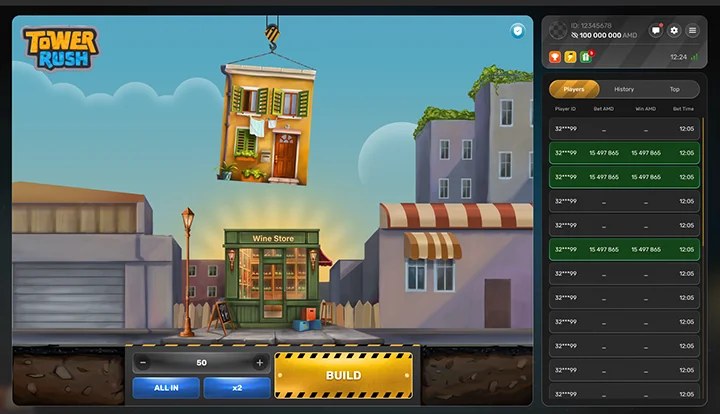
Indian players can explore the official Tower Rush demo in a mobile or desktop browser. No separate game application is required. Learn the rules, compare supported risk settings and experience Frozen Floor, Temple Floor and Triple Build with virtual credits.
Play Tower Rush Free Online
The free browser demo is the quickest way to understand Tower Rush. It provides the complete building interface, virtual credits and access to the main game features without requiring a deposit.
A round begins at the starting floor. Selecting Build asks the game to resolve the placement. A successful result adds another level to the structure and changes the current cumulative value. The sequence can then be ended, or the active tower can be exposed to another floor.
The demo is designed for product exploration. Its virtual balance has no monetary value, and a large demo result cannot be withdrawn. It is the right place to learn the interface, and the wrong place to look for an income system.
Tower Rush Play publishes the Tower Rush demo route for adults in India, together with the rules, the RTP range and the feature list. A first visit usually takes under a minute to load on a normal mobile connection, because the game is delivered as a lightweight HTML5 build rather than a downloaded client.
No Registration for Basic Demo Access
The official provider demonstration can be explored without creating a real-money casino account. That removes unnecessary registration, payment and withdrawal steps from the learning process. Open the game information panel before the first attempt and check the current RTP, the available settings, the rules and the fairness information. The live panel always takes priority over screenshots or videos created for an older version.
A demo session needs no card details, no bank details and no identity documents. Any page that requests a deposit, a fee or a document upload before showing a virtual-credit demo is not offering a standard product demonstration.
Optimised for Indian Mobile Users
The HTML5 interface runs in current versions of Chrome, Safari and Edge. Android devices can open the mobile demo directly in Chrome, while iPhone and iPad devices reach it through Safari. A browser-based design means no official standalone Tower Rush app download is required for demo play. The same central controls remain visible across supported screen sizes.
Data usage stays modest because the artwork is cached after the first load. On a slower connection the animation may step rather than glide, but the mathematics of a round does not change with connection quality. A lagging frame cannot alter a resolved result.
Tower Rush Game Overview
| Feature | Tower Rush information |
|---|---|
| Developer and provider | Galaxsys |
| Official release | 28 February 2024 |
| Game type | Fast game, turbo game and tower-building multiplier title |
| Official RTP range | 96.2% to 97.6% |
| Core objective | Complete floors and secure the cumulative value before a collapse |
| Bonus floors | Frozen Floor, Temple Floor and Triple Build |
| Maximum tower height | Described by Galaxsys as limitless |
| Fairness features | RNG technology and provable fairness |
| Demo access | Mobile and desktop browser |
| Separate game app | Not required |
| Minimum age | 18+ |
Game details should always be verified through the active rules panel. A familiar interface does not guarantee that every implementation uses the same approved RTP configuration.
What Is Tower Rush?
Tower Rush is a Galaxsys tower game built around repeated construction decisions. The objective is to assemble a skyscraper by completing one floor after another. Each successful placement contributes to the current cumulative value.
After a floor succeeds, the attempt does not continue automatically. The interface presents another choice. The displayed demo result can be secured, or Build can be selected to attempt the next level. This structure creates a clear rhythm: build, review and decide. The rules are simple enough for a newcomer to understand within a few attempts, but the cumulative system makes later decisions increasingly important.
A Tower Game With Crash-Style Tension
Tower Rush is frequently described as a crash-style game because the active value remains exposed until it is secured. However, its visual and decision structure differs from the continuous multiplier curve used by many crash titles. Instead of an aircraft rising along a curve, a structure is assembled through separate events. A completed floor creates a visible pause before the next decision. This staged design gives Tower Rush an active presentation, but it does not make floor timing a predictive skill. Selecting Build requests another result. Tapping at a particular moment cannot force a successful placement.
How Cumulative Values Work
Each completed floor contributes to the active value through multiplication. The calculation is cumulative rather than a simple addition of separate floor figures. Suppose a demo floor applies 1.40 and the next successful floor applies 1.50. Multiplying those values produces 2.10. Adding them would produce an incorrect result. Actual floor values depend on the current configuration, but the principle stays the same: every completed stage becomes part of the active sequence until the result is secured or the tower collapses.
Tower Rush Floor Factors and Compounding
A worked example makes the compounding effect easier to follow. The figures below are illustrative demo units chosen to show the arithmetic, not published floor values. Starting from 100 virtual units, four successful floors at 1.15, 1.25, 1.30 and 1.40 combine as follows.
| Build moment | Calculation | Displayed value |
|---|---|---|
| Start | 100 units | 100 |
| After floor 1 | 100 x 1.15 | 115 |
| After floor 2 | 115 x 1.25 | 144 |
| After floor 3 | 144 x 1.30 | 187 |
| After floor 4 | 187 x 1.40 | 262 |
Two details matter here. The first is that no single floor carries the result: the total of 262 units is produced by four modest factors working together. The second is that the exposed amount grows with every floor, so the cost of a collapse late in a sequence is larger than the cost of a collapse on the first floor. That is the whole tension of Tower Rush in one sentence.
It is also worth noting what compounding does not do. It does not create value out of nothing, it does not raise the published RTP, and it does not make a longer sequence mathematically better than a short one. A higher displayed value always arrives attached to a lower chance of reaching it.
Inside a Tower Rush Round
- Open the demo and review the rules. Start from a verified Galaxsys page. Open the information panel and confirm the published RTP, game version and feature descriptions. Do not begin from a predictor page or an APK download link.
- Select a virtual amount. The demo supplies virtual credits. Choose a straightforward amount so that changes in the cumulative value are easy to follow. The amount affects the displayed result but not the probability of a successful floor.
- Choose an available risk setting. Supported versions may offer trap or difficulty controls. Lower settings generally create steadier progression, while higher settings can create sharper variation. Check the current rules for the exact relationship.
- Select Build. Build requests the next floor. A successful placement increases the height and changes the active value. An unsuccessful placement ends the unprotected sequence. The outcome comes from the game system, not internet speed, button pressure or tapping rhythm.
- Decide whether to continue. After every completed floor, review the current value. A stopping point chosen before the attempt is easier to follow than one invented after the tower has grown.
- Review the completed sequence. Note how many floors were completed and whether a bonus appeared. Do not use a small result sample to calculate the official RTP or predict the next floor.
Every Tower Rush round follows that same six-part rhythm, and the rhythm is the reason the game is easy to learn. What changes between rounds is the length of the sequence and the size of the cumulative value at the moment of the decision.
Tower Rush Bonus Floors
Galaxsys identifies three bonus features: Frozen Floor, Temple Floor and Triple Build. These events interrupt normal construction and change the conditions of the active attempt. Bonus floors are generated by the game system. They cannot be summoned through an amount change, tapping pattern, time of day or secret sequence.

Frozen Floor
Frozen Floor introduces a protection effect into the tower. In configurations where it preserves an active value, the protected result can remain available even if a later stage fails. Read the current rules carefully to identify what is protected. Protection affects the consequence of failure, not the probability of success.
Temple Floor
Temple Floor introduces a separate themed bonus event, commonly displayed through a segmented wheel. A result from the wheel can apply another value or feature to the active sequence. Visible segments should not automatically be treated as equally likely, because a digital wheel can assign different mathematical weights beneath the artwork.
Triple Build
Triple Build accelerates construction by adding multiple floors through one feature sequence. It produces the fastest visible increase in tower height among the three named bonuses. Three visual floors do not necessarily mean the active value is multiplied by three. The exact calculation belongs to the current rules and configuration.
All three features sit inside the published RTP range rather than on top of it. A bonus floor changes the shape of a sequence, and it can change the size of a single result, but it does not shift the long-term mathematical expectation of the product.
Compare Tower Rush Risk Settings
| Setting | Character | What to expect |
|---|---|---|
| One trap | Steadier lane | More frequent floor success, smaller potential increase per placement |
| Two traps | Medium volatility | Less frequent success, more noticeable value growth, harder cash-out calls |
| Three traps | High volatility | Repeated early failures and occasional high-value sequences |
Steadier does not mean guaranteed. A tower can still collapse early, and a lower-risk lane does not remove the mathematical margin. A larger potential value does not automatically create better mathematical value, because it exists alongside a lower completion chance.
Tower Rush Probability Explained
The probability of completing several floors can fall quickly because every additional stage adds another event that must succeed. The table below is a simplified illustration using equally weighted positions. Treat it as an official Tower Rush calculation only if the current rules confirm the same structure.
| Illustrative setup | Success per floor | Cumulative success |
|---|---|---|
| 1 floor, 1 losing position | 66.6% | 66.6% |
| 2 floors, 1 losing position | 66.6% | 44.4% |
| 3 floors, 1 losing position | 66.6% | 29.6% |
| 5 floors, 1 losing position | 66.6% | 13.2% |
| 1 floor, 2 losing positions | 33.3% | 33.3% |
| 2 floors, 2 losing positions | 33.3% | 11.1% |
| 3 floors, 2 losing positions | 33.3% | 3.7% |
Several collapses do not make a successful sequence overdue, and several successful towers do not prove the game has entered a favourable cycle. This mistaken belief is called the gambler's fallacy, and it can lead to increased amounts and abandoned limits.
Read the table from top to bottom and a practical point appears: the jump from one floor to three floors removes more than half of the cumulative success chance in the first column. Long towers are not rare because the game is unfair. They are rare because many separate events have to line up.
Tower Rush RTP and House Margin
The official Galaxsys page currently publishes a Tower Rush RTP range of 96.2% to 97.6%. RTP means return to player. It is a theoretical long-term percentage calculated across a very large number of resolved events under defined conditions.
An RTP of 97% does not mean that every 100 rupees produces 97 back. Individual sessions can finish far above or below the theoretical average, and short sequences cannot confirm the official percentage. The difference between 100% and RTP is the theoretical house margin: a 97.6% RTP corresponds to a 2.4% margin, and a 96.2% RTP corresponds to 3.8%. The official range indicates that more than one approved configuration may exist, so check the panel inside the version being demonstrated rather than assuming it always uses the maximum RTP.
Tower Rush Worked RTP Arithmetic
The margin is small in percentage terms and large in volume terms, which is why the arithmetic deserves a worked example. Over a very large number of resolved demo events, a 97.6% RTP configuration returns 976 units for every 1000 units staked in total, and a 96.2% configuration returns 962 units.
| Configuration | Return per 1,000 units | Theoretical margin |
|---|---|---|
| 96.2% RTP | 962 units | 38 units |
| 97.0% RTP | 970 units | 30 units |
| 97.6% RTP | 976 units | 24 units |
Two conclusions follow. First, the difference between the two ends of the published range is 14 units per 1,000, which is why the panel matters more than a headline figure. Second, a margin of 2.4% to 3.8% guarantees that no sequence of rounds can be converted into a reliable profit, no matter how disciplined the stopping rules are. Discipline manages exposure and time. It does not change the return percentage.
Tower Rush Provably Fair and RNG Technology
Galaxsys lists provable fairness and RNG technology among the product's features. The Random Number Generator provides the values used to resolve game events. Device type, internet connection and button timing do not alter those values. A game history records completed attempts, but it cannot expose an unrevealed future result.
A provably fair process may use cryptographic seeds, hashes and a nonce. The system can commit to data before an event and reveal enough information afterwards for the completed result to be checked. Follow the actual verification instructions inside the game. Fairness verification takes place after a result, while prediction claims concern an outcome before it occurs, so a provably fair design does not give any external application access to hidden data, and it does not remove the house margin.
Tower Rush Versus Aviator
| Feature | Tower Rush | Aviator |
|---|---|---|
| Main visual | Tower constructed floor by floor | Aircraft moving along a rising curve |
| Decision style | Separate Build or Cash Out decisions | Continuous cash-out window |
| Bonus features | Frozen Floor, Temple Floor, Triple Build | No comparable mid-round floor bonuses |
| Official RTP | 96.2% to 97.6% | Check the current Aviator panel |
| Best suited to | Players who prefer staged progression | Players who prefer a minimal continuous interface |
| Predictor reliability | No guaranteed predictor | No guaranteed predictor |
Both formats involve random outcomes and uncertain continuation. Neither can be predicted through previous rounds, tapping patterns or external signal applications.
The practical difference is the pace of decision-making. Aviator asks for one timing call inside a moving window. Tower Rush asks for a fresh decision after every resolved floor, so the number of decision points inside a single round is higher and the round can be ended at any completed stage.
Tower Rush Mobile Access
The official demo is delivered through HTML5, so it opens in a current version of Chrome, Safari or Edge. The interface adapts to phone, tablet and desktop screens, and the mathematical rules and RTP configuration do not change because a different device is used. Supported browsers can create a home-screen shortcut for quicker access, but that shortcut simply opens the verified browser page. It does not convert the browser route into an official standalone application.
A Tower Rush APK can be created and renamed by anyone, and a copied logo does not prove that the file comes from Galaxsys. Do not install files advertised as predictors, unlimited-money editions or modified games. They may request access to messages, notifications, contacts or accessibility services.
Is Tower Rush Real or Fake?
The original Tower Rush game is real and can be verified through Galaxsys, which publishes the game's release details, RTP range, feature names and demo access. The primary risks come from unrelated products using the name. Check that Galaxsys appears inside the product information, compare the interface with the provider's official screenshots, and confirm the page uses HTTPS. HTTPS protects the connection, but it does not independently verify the business behind the page. No legitimate random game can promise that every attempt will succeed, so a page advertising fixed daily income or guaranteed withdrawals is misrepresenting the product.
Tower Rush Predictor Scam Warning
No Tower Rush predictor app can guarantee the next floor, bonus or collapse result. A fake tool can generate random guesses and highlight the ones that match by chance, while failed predictions are quietly deleted. An administrator can send different predictions to separate groups, then promote the successful message after the event while the others disappear. Some channels charge for premium signals after showing several apparent wins, but payment does not provide access to the hidden RNG data.
Never provide a password, OTP, identity document or remote screen access to a signal seller. If an unknown APK has been installed, remove its permissions, uninstall it, scan the device and change any password entered through the application.
Tower Rush Session Strategies
No strategy can change a random floor result. A responsible strategy manages time, exposure and decision consistency. A conservative approach uses the lowest available risk setting and an early stopping point chosen before the attempt begins. A target-based approach fixes a maximum number of floors or a virtual multiplier range and ends each attempt when the target is reached. A bonus-observation approach uses a small virtual amount and a fixed session duration, without continuing indefinitely until a particular feature appears.
| Demo style | Risk lane | Main objective | Stop rule |
|---|---|---|---|
| Conservative | Lowest supported | Learn basic progression | Early predetermined exit |
| Target-based | Low or medium | Practise consistent decisions | Fixed floor or value target |
| Bonus observation | Any selected lane | Identify bonus behaviour | Fixed time and attempt cap |
| High-volatility test | Highest supported | Understand result variation | Separate short session limit |
Each of those four styles works best in demo mode, where the amount is virtual and the only thing being measured is consistency. A plan that cannot be followed in demo mode will not survive the pressure of a real balance.
Tower Rush Terminology
The vocabulary around crash-style games is not always consistent between platforms, so the table below lists the terms used across the Tower Rush Play guides together with their plain meaning.
| Term | Meaning in Tower Rush |
|---|---|
| Floor | One resolved construction step that either completes or ends the sequence |
| Cumulative value | The compounded figure currently displayed and available to secure |
| Build | The control that requests the next floor |
| Cash out | The control that secures the displayed value and ends the round |
| Collapse | An unsuccessful placement that ends the unprotected sequence |
| Trap setting | The difficulty or volatility lane chosen before the round begins |
| RTP | Return to player, a theoretical long-term percentage published by the provider |
| House margin | The difference between 100% and the published RTP |
| Provably fair | A verification method that allows a completed result to be checked after the event |
| Nonce | A counter value used inside a provably fair verification sequence |
Tower Rush Safety Checklist
Tower Rush is an adult product, and the demo route should be treated with the same care as any other form of play. The checklist below covers the checks that belong before a session rather than during one.
| Check | Why it matters |
|---|---|
| Confirm the source is Galaxsys | A copied interface is not proof of an official build |
| Read the rules panel first | RTP, features and settings can differ between versions |
| Fix a time limit before starting | Session length is the easiest thing to control and the easiest to lose track of |
| Fix a stopping point in advance | A target chosen after the tower has grown is not a plan |
| Refuse every predictor offer | No external tool can read an unrevealed random result |
| Keep the demo virtual | Virtual credits carry no value and cannot be withdrawn |
| Stop when play stops being fun | Enjoyment is the only reliable measure of a healthy session |
Tower Rush in India: Legal and Responsible Play
India's Promotion and Regulation of Online Gaming Act, 2025 came into force in 2026 and prohibits online money games, their advertising and the related fund transfers. Tower Rush Play is published as a game guide and demo resource for adults in India, which is why the Tower Rush demo route is the route we present first and in most detail.
The legal position is national rather than state by state for the purposes of this guide. A reader in any Indian state should assume that money play in a crash-style game is restricted, and should therefore treat the demo as the full product experience rather than as a trial for something else. Nothing on Tower Rush Play is an invitation to deposit, and no page on Tower Rush Play promises a return.
Responsible play in this context has three practical parts. The first is time: a fixed session length decided before the browser tab is opened. The second is attention: no session while tired, upset or distracted. The third is honesty: no attempt to recover a previous result by extending a session, because the previous result has no influence on the next one.
Tower Rush Multiplier Examples: Three Worked Rounds
Three short worked rounds show how differently the same game can behave without any change to the underlying mathematics. All figures are illustrative demo units, and all three rounds start from 100 virtual units.
| Round | Sequence of floor factors | Outcome |
|---|---|---|
| Short and steady | 1.20 then secured | 120 units secured after one floor |
| Medium with one collapse | 1.25, 1.35, then collapse | Sequence ends, no value secured |
| Long with a late exit | 1.15, 1.20, 1.30, 1.45, then secured | 262 units secured after four floors |
The middle round is the one worth studying. Two floors resolved successfully and the value climbed above 168 units, yet the sequence ended without a secured result. That is not a malfunction, and it is not evidence that the round was manipulated. It is the ordinary consequence of continuing past a completed floor.
The comparison also shows why a stopping rule has to be written before the round rather than after the third floor. In the third round, the decision point that mattered most was the fourth floor, when the value was already 181 units and the remaining factor was still unproven.
Tower Rush Demo Lab: A Five Session Learning Plan
A demo balance is most useful when the sessions have a purpose. The plan below spreads five short visits across the main controls, so that each session adds one skill instead of repeating the same first minute five times.
| Session | Focus | Ends when |
|---|---|---|
| First visit | Read the rules panel and identify every control on screen | Ten resolved floors have been observed |
| Second visit | Compare the trap settings on the same starting amount | Each supported setting has been tried once |
| Third visit | Practise securing a value after a fixed number of floors | The chosen floor count is reached in five separate rounds |
| Fourth visit | Observe how the three bonus floors appear without chasing them | The timer expires, whatever has appeared |
| Fifth visit | Test a high-volatility lane with a deliberately short session | The short limit is reached |
The order matters. Controls come before comparisons, comparisons come before stopping rules, and stopping rules come before any experiment with a sharper risk lane. A demo balance is virtual, so nothing is at stake financially, but the habits formed in demo mode are the habits carried into every later session.
Tower Rush Session Limits and Planning
Tower Rush does not include a financial brake, because a virtual balance cannot be lost. A limit therefore has to come from outside the game: a timer, a written floor count or a fixed number of rounds. Three limits are worth writing down before the browser tab is opened.
A time limit is the easiest to enforce and the easiest to forget, so it should be set on a device that is not the one being played on. A round limit caps exposure in a way that does not depend on any result, which is why it is more reliable than a value target. A session-frequency limit, such as one session on a chosen day, prevents the slow drift from occasional exploration into a daily routine.
None of the three limits improves the return percentage, and none of them can turn a negative-expectation product into a positive one. What they do is keep the amount of time and attention spent on Tower Rush inside a deliberate boundary rather than an accidental one.
Tower Rush on Desktop Versus Mobile
| Detail | Tower Rush on desktop | Tower Rush on mobile |
|---|---|---|
| Layout | Wider frame, side information visible at once | Single-column stack, controls grouped at the base |
| Controls | Mouse and keyboard | Touch |
| Maths and RTP | Unchanged | Unchanged |
| Data use | Higher on first load | Lower after artwork is cached |
| Best for | Reading the rules panel in detail | Short observation sessions |
The interface changes between the two, and the mathematics does not. That distinction is worth repeating, because a slower phone or a smaller screen is often blamed for a result that was simply a resolved random outcome.
Tower Rush Common Misunderstandings
Four beliefs appear often enough in Tower Rush discussions to be worth correcting directly. Each one is understandable, and each one leads to worse decisions.
The first is that a long run without a bonus floor makes a bonus floor due. Bonus events are resolved independently, so a quiet stretch carries no debt. The second is that a higher trap setting raises the possible return, when it actually changes the shape of the variation and leaves the published RTP untouched. The third is that a predictor can read the next result, when the result does not exist until the game resolves it. The fourth is that a disciplined stopping rule makes Tower Rush profitable, when a stopping rule only controls how long an exposure lasts.
Correcting those four beliefs removes most of the confusion around crash-style games. What remains is the honest position: Tower Rush is a random product with a published RTP range, a clear interface and a demo route that costs nothing to explore.
Tower Rush FAQ
What is the Tower Rush game?
Tower Rush is a Galaxsys tower game in which successful floors increase a cumulative value. After each completed stage, a decision follows: secure the result or request another build.
Who developed Tower Rush?
Galaxsys developed and publishes the original Tower Rush. The provider supplies official product information and mobile and desktop demo access.
What is the official Tower Rush RTP?
Galaxsys currently publishes a range of 96.2% to 97.6%. Check the current game panel to identify the configuration being demonstrated.
Is Tower Rush playable for free?
Yes. The official browser demo uses virtual credits and does not require a deposit. Virtual results cannot be withdrawn.
Is the Tower Rush app required?
No standalone application is required for the official demo. It runs through current Android, iOS and desktop browsers.
What are the Tower Rush bonus floors?
The three named features are Frozen Floor, Temple Floor and Triple Build. Their exact effects should be checked in the current rules.
Is Tower Rush real or fake?
The Galaxsys game is real. Predictor applications, imitation pages and guaranteed-income products using the name may be fraudulent.
Do Tower Rush predictors work?
No predictor can guarantee future random outcomes. Screenshots and signal messages do not prove access to hidden game data.
Is Tower Rush the same as Aviator?
No. Tower Rush uses separate floor-building decisions and three named bonus features. Aviator uses a continuous aircraft multiplier interface.
Is real-money Tower Rush play permitted in India?
India's Promotion and Regulation of Online Gaming Act, 2025 came into force in 2026 and prohibits online money games, their advertising and related fund transfers. The free Tower Rush demo is the route we present for adults in India.
Play Tower Rush Responsibly
Tower Rush is intended for adults aged 18 and above. Use the game as entertainment and product exploration, never as an income plan. Set a session timer before opening the demo and stop when the limit is reached. Do not chase losses, borrow money or expose funds required for household expenses. Take regular breaks and close the game if play causes anxiety or a loss of control.
If gambling is affecting an individual or a household, support is available in India through Aasra on 91-9820466726 and other services such as Gamblers Anonymous. Tower Rush Play publishes game education and demo guidance, and the Tower Rush demo uses virtual credits only.
Tower Rush Play: Content Standards and Updates
Tower Rush Play is the publisher of this guide and the platform behind the Tower Rush demo route for India. We maintain the Tower Rush pages, we check the Galaxsys product details before every review, and we keep each published figure aligned with the active rules panel inside the game.
Where a number can change, such as the RTP configuration or a feature name, we state the source rather than presenting the figure as permanent. Where a claim cannot be verified, such as the output of a prediction tool, we say so plainly instead of repeating it. Product names and trademarks belong to their respective owners.
Corrections are welcome through our contact page. If a published detail no longer matches the provider's current rules, we update the page and move the review date forward rather than leaving an outdated figure in place.